
How Precisely Does Drops of God Show Georgia?
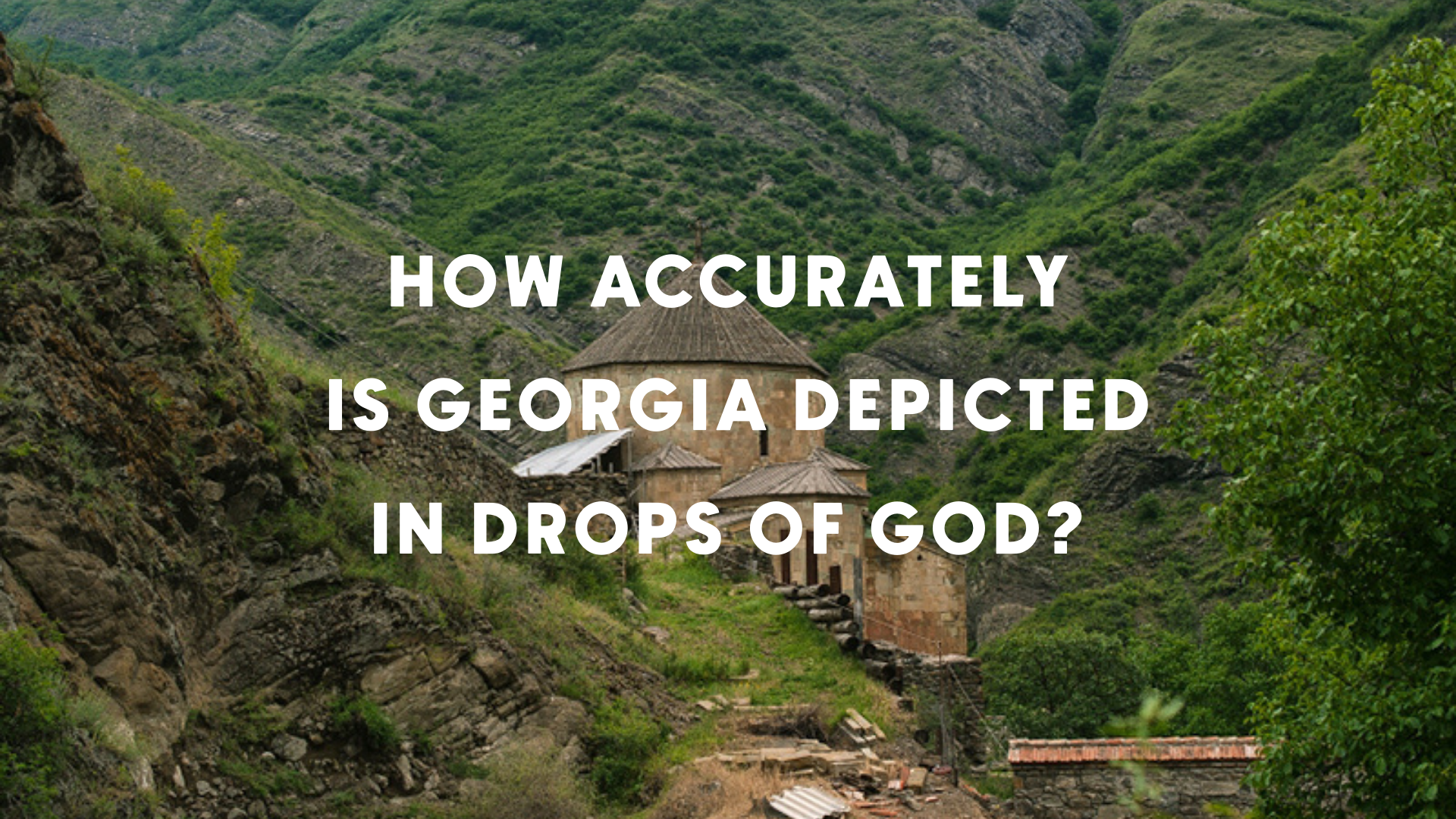
Ateni Sioni Church, Georgia
5th March 2026
We all know how films work. If the plot needs a touch of the “exotic”, we suddenly get yellow filters, a chaotic bazaar, oranges and spices flying in the air while the hero escapes on the motorbike. Viewers from Morocco or Egypt tend to cringe.
Georgian viewers, however, were pleasantly surprised by how believable Georgia looked in Drops of God. So we decided to answer the questions you might have asked yourself while watching.
1. Is there really a monastery in Ateni?
Yes. Atenis Sioni monastery is very real, and it has been functioning since the 6th century. Its terraced vineyards are tended by monks who make their own wine.
The Ateni Valley, in the Kartli region, is a very special terroir and the home of Georgia’s only traditional-method sparkling PDO: Atenuri. Today it’s a true rarity on the market.
Still dry blends of Chinuri and Goruli Mtsvane from Ateni are also quite rare, but you can taste one of the finest examples at Nika Vacheishvili’s Marani. The Apple TV crew also stayed there during filming, and the owners are deeply knowledgeable about both the history of the area and local viticulture.
2. Can you visit the monastery cellar shown in the series?
Not really. The monastic cellar itself is not open to tourists, and it is not connected to a private home as shown on screen. The monks do sell their wine in the church shop.
The cellar featured in the series used to belong to the noble Orbeliani family, but today it is no longer in use.
3. Do they really grow the Herbemont variety in the vineyards?
In reality, the vineyards of Ateni are planted with local Vitis vinifera varieties: Chinuri, Goruli Mtsvane,Tavkveri and Shavkapito. Many of us were hoping the “mystery wine” would be based on one of these (Shavkapito would have been a brilliant choice), but the series went in a more exotic direction.
There is no Herbemont in Kartli. There is, however, a hybrid grape called Dirbula. It is mostly used for homemade wines thanks to its disease resistance and low need for spraying, but it is not considered a quality variety and tends to produce wines with high methanol and a rather rustic taste.
One French grape you might genuinely encounter in this part of Kartli is Aligoté, which was widely planted in the 20th century for sparkling blends.
Isn't this whole answer a great material for a Georgian wine trivia night?!
4. Do Georgians really welcome strangers into family feasts like that?
Yes, they do. The author of this article once ended up at a Georgian birthday party by accident, spent a New Year’s Eve with complete strangers, and made friends for life.
Hospitality here is real. It is very hard to leave a supra, and even harder to stop people offering you food. The food is excellent, by the way.
So if you have a plane to catch, please don't mention tricky issues such as mysterious wine or estranged relatives as a shortcut to exit - while Camille and Issei were asked to leave, it doesn't always work this way in real life.
5. Okay, I can't go to Georgia right now, but what if I want to drink some of the wines Camille, Issei and Davit drank at the fancy golf resort?
We do hope you make it to Georgia one day — there are direct flights from the UK. But if not, we checked the wine list of the resort featured in the series, and several producers are available in the UK.
Look out for wines from:
And if you’d like to go further, explore our guide to Kartli and Kakheti or check out our list of the rare Georgian varieties, and plan your own, less dramatic, but equally rewarding search for ancient wine in the cradle of wine.
